

AI Translator
Instant translation powered by Google Neural
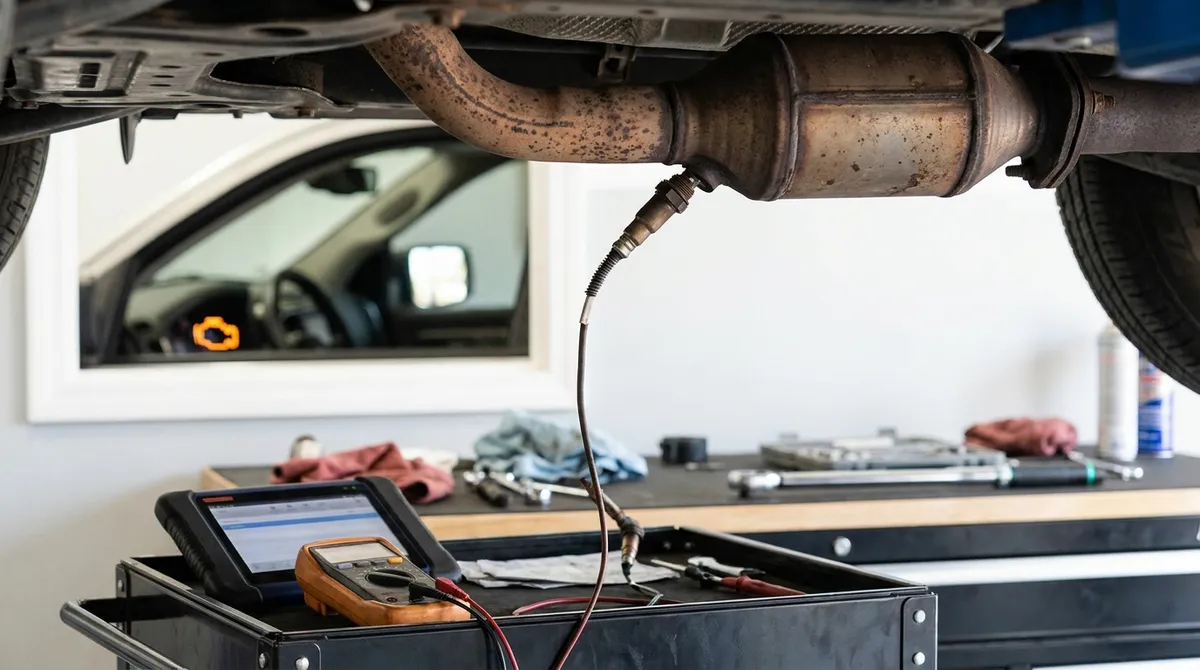
Figure 1: P0420 Diagnostic Setup — OBD2 scanner showing P0420 code, catalytic converter, and check engine light indicator.
🔴 P0420 Code: Complete Guide to Catalyst System Efficiency Below Threshold (Bank 1) | 2026
P0420 stands for "Catalyst System Efficiency Below Threshold (Bank 1)". It means your vehicle's Powertrain Control Module (PCM) has detected that the catalytic converter on Bank 1 (the side of the engine containing cylinder #1) is not operating at the required efficiency level. This is one of the most common OBD-II emissions codes and can stem from the catalytic converter itself, faulty O2 sensors, exhaust leaks, or underlying engine problems.
📑 Table of Contents
🔍 What Does P0420 Mean?
The P0420 diagnostic trouble code (DTC) indicates that the efficiency of the catalyst system on Bank 1 is below the threshold required by the vehicle's Powertrain Control Module (PCM). Bank 1 refers to the side of the engine that contains cylinder number one.
The catalytic converter is a critical emissions control device that converts harmful pollutants — carbon monoxide (CO), hydrocarbons (HC), and nitrogen oxides (NOx) — into less harmful substances like carbon dioxide (CO₂), water (H₂O), and nitrogen (N₂). It does this using a ceramic honeycomb structure coated with precious metals (platinum, palladium, and rhodium).
Your vehicle uses two oxygen (O₂) sensors to monitor the converter's performance:
- Upstream O₂ Sensor (Sensor 1): Located before the catalytic converter, it monitors the exhaust gases entering the converter.
- Downstream O₂ Sensor (Sensor 2): Located after the catalytic converter, it monitors the exhaust gases exiting the converter.
Under normal operation, the upstream sensor should fluctuate rapidly (rich/lean cycles), while the downstream sensor should remain relatively stable with minimal fluctuation because the catalytic converter has "cleaned" the exhaust. When the PCM detects that the downstream sensor readings are too similar to the upstream sensor readings, it concludes the catalytic converter is not working efficiently and triggers P0420.
P0420 does NOT always mean the catalytic converter is bad. In many cases, the root cause is a faulty O₂ sensor, exhaust leak, engine misfire, or fuel system issue. Proper diagnosis is essential before spending money on an expensive catalytic converter replacement.
📊 Diagram 1: Fuel Injection Feedback Loop with O2 Sensors
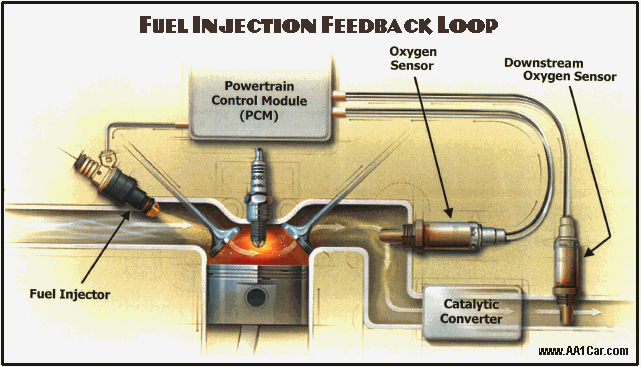
Figure 2: The complete fuel injection feedback loop — how the PCM uses upstream and downstream O2 sensors to monitor and adjust fuel delivery.
📊 Diagram 2: Exhaust System O2 Sensor Layout
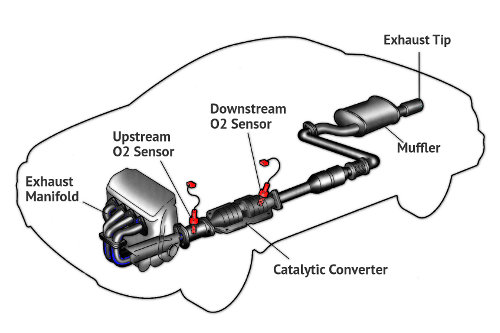
Figure 3: Complete exhaust system showing upstream (pre-cat) and downstream (post-cat) O2 sensor positions relative to the catalytic converter.
🔬 Diagram 3: Catalytic Converter Internal Structure

Figure 4: Cross-section of a catalytic converter showing the ceramic honeycomb structure coated with platinum, palladium, and rhodium catalyst materials.
⚠️ Symptoms of P0420 Code
In many cases, the only noticeable symptom is the illuminated Check Engine Light (CEL). However, depending on the severity and root cause, you may experience the following:
| Symptom | Severity | Description |
|---|---|---|
| 🔴 Check Engine Light ON | High | Steady or flashing CEL on dashboard. P0420 stored in PCM memory. |
| ⛽ Reduced Fuel Economy | Medium | Drop of 10-20% in MPG due to inefficient combustion or rich running condition. |
| 🐌 Loss of Power / Poor Acceleration | Medium-High | Clogged converter restricts exhaust flow, causing backpressure and reduced engine output. |
| 🥚 Rotten Egg / Sulfur Smell | Medium | Hydrogen sulfide (H₂S) odor from exhaust indicates converter is overheating or failing. |
| 🔊 Rattling Noise from Exhaust | High | Internal ceramic honeycomb has broken apart and is rattling inside the converter housing. |
| ❌ Failed Emissions Test | High | Vehicle will fail smog/inspection in states/countries with mandatory emissions testing. |
| 🚗 Rough Idle or Stalling | Low-Medium | Caused by underlying misfire or vacuum leak, not the converter itself. |
| 💨 Dark / Excessive Exhaust Smoke | Medium | Oil or coolant burning in the engine contaminating the converter. |
If your Check Engine Light is FLASHING (not steady), this indicates an active misfire that is dumping raw fuel into the catalytic converter. Stop driving immediately — a flashing CEL can cause the converter to overheat and melt internally, leading to a fire hazard and very expensive repairs.
🔧 Common Causes of P0420 Code
P0420 is a "system" code, meaning multiple components can trigger it. Here are the causes ranked by likelihood:
1. Faulty or Degraded Catalytic Converter
The most common cause. Converters naturally degrade over time (typically 100,000+ miles / 160,000+ km), but premature failure is usually caused by:
- Engine misfires — Unburned fuel enters the exhaust and overheats the converter.
- Oil or coolant contamination — Burning oil (worn piston rings, valve seals) or coolant (blown head gasket) coats the catalyst, poisoning it.
- Physical damage — Road debris, speed bumps, or corrosion can crack the housing or damage the honeycomb.
- Overheating — Rich fuel mixture or restricted exhaust flow causes the converter to run excessively hot.
2. Faulty Oxygen (O₂) Sensors
O₂ sensors have a finite lifespan (typically 60,000–100,000 miles). A lazy or inaccurate downstream O₂ sensor can falsely trigger P0420 even if the converter is fine. Conversely, a faulty upstream sensor can cause the engine to run rich/lean, damaging the converter over time.
3. Exhaust Leaks (Before the Converter)
Leaks in the exhaust manifold, gasket, or pipes before the catalytic converter allow outside air to enter the exhaust stream. This extra oxygen skews the O₂ sensor readings, making the PCM think the converter is inefficient.
4. Engine Misfires
Misfires (P0300–P0312 codes) dump unburned fuel into the exhaust. The catalytic converter tries to burn this fuel, causing it to overheat and melt internally. Always fix misfires before replacing a catalytic converter.
5. Rich or Lean Fuel Mixture
Problems with the fuel system — such as a faulty MAF sensor, dirty injectors, leaking fuel pressure regulator, or vacuum leaks — can cause the engine to run too rich or too lean. Both conditions stress the converter and reduce its lifespan.
6. Contaminated or Wrong Fuel
Using leaded fuel (rare today), excessive fuel additives, or contaminated fuel can poison the catalyst. Even high-sulfur fuel can contribute to premature converter failure.
7. PCM Software Issues
Some vehicles (especially Honda, Toyota, and Ford) have overly sensitive catalyst monitoring software. A PCM software update from the dealer can sometimes resolve false P0420 codes without any parts replacement.
Before replacing any parts, always check for related codes (P0171, P0172, P0300, P0301, etc.). Fix those first — they are often the root cause of P0420.
🚗 Vehicles Most Commonly Affected by P0420
P0420 can appear on any vehicle with OBD-II (1996+), but some makes and models are more prone due to design quirks, software sensitivity, or known issues:
| Brand | Common Models | Known Issues |
|---|---|---|
| Toyota | Camry, Corolla, Prius, RAV4, Tacoma | Highly sensitive catalyst monitoring; oil burning in older engines; TSBs for PCM recalibration available. |
| Honda | Civic, Accord, CR-V, Odyssey, Pilot | V6 models consume oil; software updates common fix; weak downstream O₂ sensors. |
| Nissan | Altima, Murano, Pathfinder, Maxima, Sentra | MAF sensor contamination; intake leaks; poor downstream O₂ heater circuit performance. |
| Subaru | Forester, Outback, Impreza, Legacy | Boxer engine oil consumption; converter positioned low, prone to damage. |
| Ford | F-150, Focus, Fusion, Escape, Explorer | Turbo inefficiency; over-fueling; exhaust manifold cracks on V8 models. |
| Chevrolet | Silverado, Equinox, Cruze, Malibu | Exhaust manifold cracks (V8); excessive soot from city driving; direct injection carbon buildup. |
| Hyundai / Kia | Sonata, Elantra, Tucson, Sportage, Sorento | Theta II engine issues; catalytic converter integrated into exhaust manifold. |
| BMW / Mercedes | 3-Series, 5-Series, C-Class, E-Class | Expensive OEM converters; multiple O₂ sensors; complex exhaust systems. |
| Volkswagen | Jetta, Golf, Passat, Tiguan | Turbocharged engines sensitive to boost leaks; direct injection carbon on intake valves. |
🛠️ How to Diagnose P0420 Code (Step-by-Step)
Accurate diagnosis saves hundreds of dollars. Follow this systematic approach:
Step 1: Scan for All Codes
Use an OBD-II scanner to retrieve all stored and pending codes. Do not just look at P0420 — check for related codes that point to the root cause:
- P0171 / P0172 → Fuel trim issues (lean/rich)
- P0300–P0312 → Engine misfires
- P0130–P0167 → O₂ sensor circuit problems
- P0420 + P0430 → Both banks affected (likely fuel or exhaust issue)
Step 2: Review Freeze Frame Data
Check the freeze frame data to see engine conditions when P0420 was set (RPM, coolant temp, vehicle speed, fuel trim). This helps identify if the issue occurs at idle, cruise, or under load.
Step 3: Visual Inspection
- Inspect O₂ sensor wiring for fraying, burning, or disconnection.
- Check exhaust system for visible leaks, rust holes, or damaged hangers.
- Look for oil or coolant residue around the exhaust (signs of internal engine leak).
- Tap the catalytic converter lightly — a rattling sound indicates internal honeycomb damage.
Step 4: Test O₂ Sensors with Live Data
Using a scan tool with live data capability:
- Upstream O₂ Sensor (Bank 1 Sensor 1): Should fluctuate rapidly between 0.1V and 0.9V.
- Downstream O₂ Sensor (Bank 1 Sensor 2): Should be relatively stable around 0.45V–0.55V with slow, minimal fluctuations.
- If the downstream sensor mirrors the upstream sensor's rapid fluctuations, the converter is likely bad OR the downstream sensor is faulty.
📈 Diagram 4: O2 Sensor Bank Positions (Longitudinal Engine)
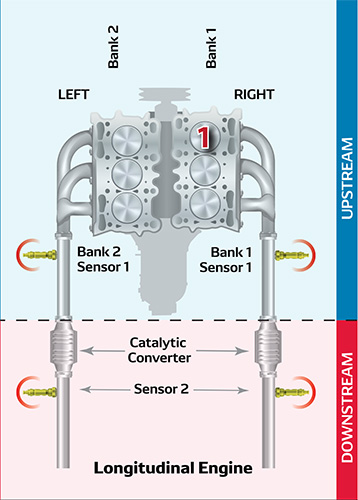
Figure 5: O2 sensor positions on a longitudinal engine — Bank 1 Sensor 1 (upstream) before the cat, and Bank 1 Sensor 2 (downstream) after the cat.
Step 5: Induce Rich/Lean Conditions
To test O₂ sensor response:
- Rich condition: Spray propane into the intake — upstream sensor should read high (0.8V+), downstream should lag.
- Lean condition: Disconnect a vacuum hose — upstream should read low (0.1V), downstream should follow slowly.
- If sensors don't respond correctly, replace the faulty sensor before condemning the converter.
Step 6: Check for Exhaust Leaks
Use a smoke machine or soapy water spray on exhaust joints while the engine runs. Bubbles indicate leaks. Pay special attention to:
- Exhaust manifold gasket
- Manifold-to-pipe flange
- Flex pipe section
- Converter inlet/outlet gaskets
Step 7: Catalytic Converter Efficiency Test
Two reliable methods:
- Temperature Test: Use an infrared thermometer. The outlet of the converter should be 100°F–200°F (55°C–110°C) hotter than the inlet during normal operation. If temperatures are similar or the inlet is hotter, the converter is not working.
- Backpressure Test: Remove the upstream O₂ sensor and install a backpressure gauge. At 2,500 RPM, pressure should be less than 1.5 psi. Higher pressure indicates a clogged converter.
🔁 Diagram 5: PCM Catalyst Monitoring Logic Flowchart
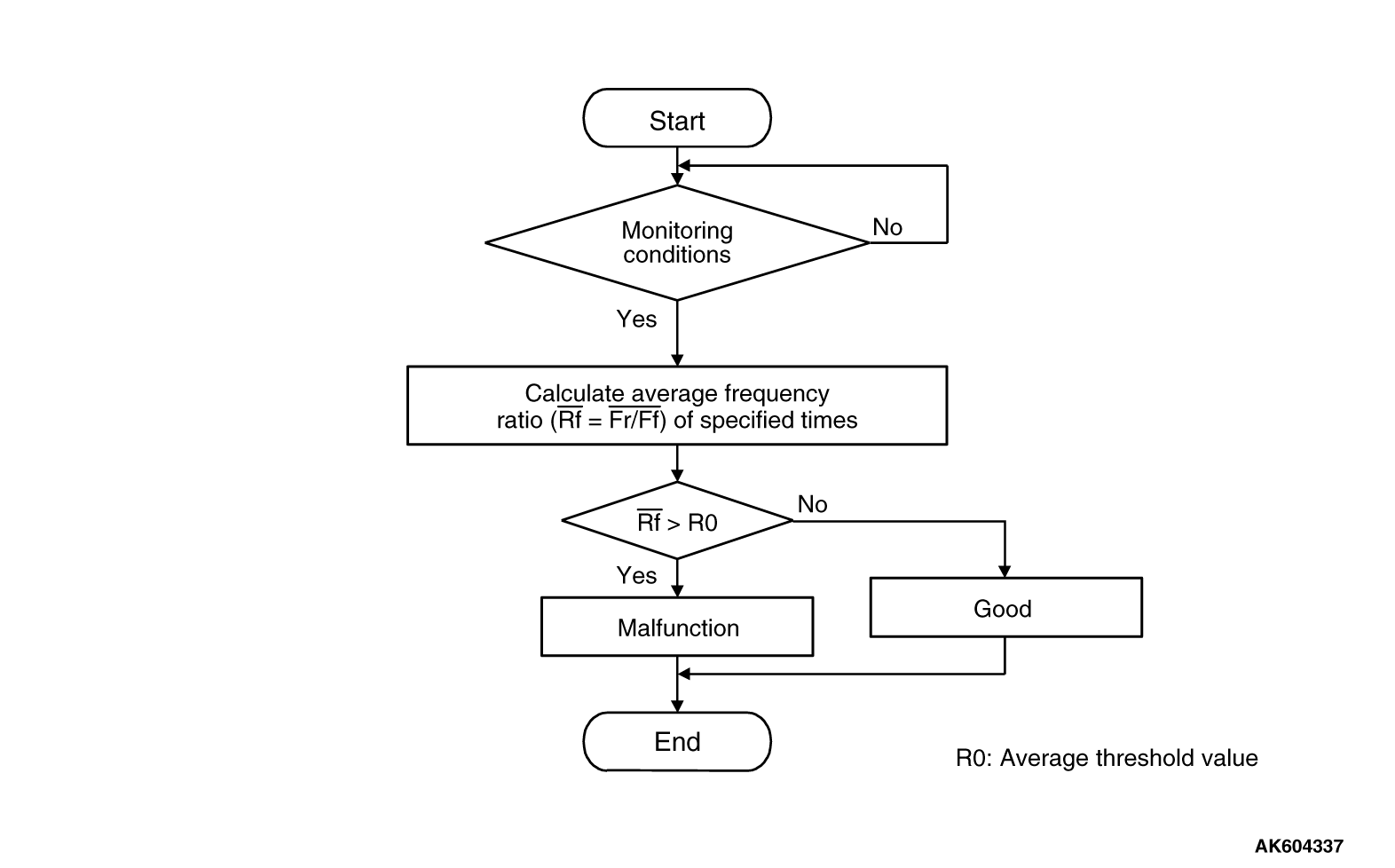
Figure 6: How the PCM determines catalyst efficiency — comparing upstream vs downstream O2 sensor frequency ratios against a calibrated threshold.
Step 8: Check Engine Health
- Perform a compression test to rule out internal engine issues.
- Check for coolant in oil or oil in coolant (head gasket failure).
- Inspect spark plugs for oil fouling, coolant fouling, or abnormal wear.
Before replacing the catalytic converter, confirm:
- ✅ No related engine codes (misfire, fuel trim, O₂ sensor)
- ✅ No exhaust leaks before the converter
- ✅ O₂ sensors respond correctly to rich/lean tests
- ✅ Converter inlet is cooler than outlet (temperature test)
- ✅ Exhaust backpressure is within spec
- ✅ No internal engine issues (compression, oil/coolant contamination)
🆚 Diagram 6: Clean vs Clogged Catalytic Converter

Figure 7: Visual comparison of a clean (free-flowing) vs clogged (carbon-coated) catalytic converter honeycomb core.
🔩 Step-by-Step Repair Guide for P0420
Based on your diagnosis, follow the appropriate repair path:
Option A: O₂ Sensor Replacement (Easiest & Cheapest)
- Identify the faulty sensor — Upstream (Bank 1 Sensor 1) or Downstream (Bank 1 Sensor 2).
- Locate the sensor — Follow the exhaust pipe from the engine. Upstream is before the cat; downstream is after.
- Disconnect the battery — Negative terminal first for safety.
- Disconnect the sensor connector — Unplug the electrical connector (may need to trace wiring to a clip).
- Remove the old sensor — Use an O₂ sensor socket (22mm or 7/8") and a ratchet. Apply penetrating oil if seized.
- Install the new sensor — Apply anti-seize compound to the threads (if not pre-applied). Hand-tighten, then torque to spec (typically 30–50 Nm).
- Reconnect everything — Plug in the connector and reconnect the battery.
- Clear codes and test drive — Use a scanner to clear P0420. Drive for 20–30 minutes to allow the PCM to run catalyst monitors.
Option B: Exhaust Leak Repair
- Identify the leak location — Visual inspection, smoke test, or soapy water spray.
- Replace the gasket — Most common fix for manifold and flange leaks. Use a new OEM or high-quality aftermarket gasket.
- Repair or replace the pipe — For rusted or cracked sections, cut out the damaged area and weld in a replacement section, or replace the entire pipe assembly.
- Torque all fasteners to spec — Exhaust bolts stretch; replace if necessary and torque in sequence.
- Clear codes and verify — Monitor O₂ sensor readings to confirm normal operation.
Option C: Catalytic Converter Replacement (Most Expensive)
- Confirm the converter is actually bad — Do NOT skip diagnosis steps.
- Order the correct replacement — Match OEM part number or use a direct-fit aftermarket converter. WARNING: Cheap universal converters may not meet EPA/CARB standards and can trigger P0420 again.
- Allow the exhaust to cool completely — Wait at least 2 hours after driving.
- Spray all fasteners with penetrating oil — Let sit for 15 minutes.
- Remove the old converter — Unbolt flanges or cut out welded sections. Support the exhaust with a jack stand to prevent stress on other components.
- Install the new converter — Use new gaskets and hardware. Torque to manufacturer specifications in a star pattern.
- Replace O₂ sensors if old — If sensors have 80,000+ miles, replace both upstream and downstream to prevent future issues.
- Clear codes and perform a relearn drive cycle — Drive at varying speeds (highway and city) for 50–100 miles to allow the PCM to complete all readiness monitors.
Option D: Try Catalytic Converter Cleaner (Temporary Fix)
- Buy a reputable cleaner — Cataclean, CRC Guaranteed to Pass, or Liqui Moly Catalytic System Cleaner.
- Add to a near-empty fuel tank — Follow product instructions (usually 1 bottle per 15 gallons).
- Drive aggressively for 15–20 minutes — High RPMs and highway speeds help the cleaner work.
- Refill with high-quality fuel — Top off the tank with premium unleaded.
- Clear codes and monitor — Success rate is 20–30% for mild carbon buildup. Will NOT fix physical damage.
Never attempt to "hollow out" or remove the catalytic converter. This is illegal in virtually all countries (Clean Air Act in USA, MOT requirements in UK, etc.) and can result in heavy fines, failed inspections, and permanent engine damage. It will also void your warranty.
💰 P0420 Repair Cost by Country (2026 Updated)
Repair costs vary dramatically depending on the root cause, vehicle make/model, and your location. Below are estimated ranges for 2026:
| Repair Type | 🇺🇸 USA | 🇬🇧 UK | 🇦🇪 UAE | 🇮🇳 India |
|---|---|---|---|---|
| O₂ Sensor Replacement (1 sensor, parts + labor) | $100 – $350 | £80 – £280 | AED 370 – AED 1,300 | ₹3,000 – ₹12,000 |
| O₂ Sensor Replacement (both sensors, parts + labor) | $200 – $600 | £160 – £480 | AED 740 – AED 2,200 | ₹6,000 – ₹22,000 |
| Exhaust Leak Repair (gasket replacement) | $150 – $400 | £120 – £320 | AED 550 – AED 1,500 | ₹4,000 – ₹15,000 |
| Exhaust Leak Repair (pipe/manifold replacement) | $300 – $800 | £240 – £640 | AED 1,100 – AED 3,000 | ₹8,000 – ₹30,000 |
| Aftermarket Catalytic Converter (direct-fit, CARB/EPA compliant) | $400 – $1,200 | £320 – £960 | AED 1,500 – AED 4,500 | ₹12,000 – ₹40,000 |
| OEM Catalytic Converter (genuine dealer part) | $800 – $2,500 | £640 – £2,000 | AED 3,000 – AED 9,200 | ₹25,000 – ₹80,000 |
| Converter + Both O₂ Sensors (complete job, OEM parts) | $1,200 – $3,200 | £960 – £2,560 | AED 4,500 – AED 12,000 | ₹35,000 – ₹1,00,000 |
| PCM Software Update (dealer only) | $100 – $250 | £80 – £200 | AED 370 – AED 900 | ₹3,000 – ₹8,000 |
💡 Money-Saving Tip: If your vehicle is under warranty (typically 8 years / 80,000 miles for emissions components in the USA), the catalytic converter may be covered free of charge. Check your warranty booklet or contact your dealer.
Average Total Repair: $500 – $1,500
🚦 Can I Drive With P0420 Code?
Short answer: Yes, but with caution and for a limited time only.
P0420 is NOT an immediate "stop driving" code like P0300 (misfire) or P0217 (overheating). However, continuing to drive with an unresolved P0420 code carries several risks:
| Scenario | Can You Drive? | Risk Level |
|---|---|---|
| Steady CEL, no other symptoms | Yes — short distances only | Low-Medium |
| Flashing CEL + P0420 | NO — Stop immediately | Very High |
| P0420 + misfire codes (P030x) | NO — Stop immediately | Very High |
| Strong sulfur/rotten egg smell | Limited driving to mechanic | High |
| Rattling noise from converter | Limited driving to mechanic | High |
| Failed emissions test required | Cannot drive legally | High |
- Increased fuel consumption (10–20% worse MPG)
- Failed emissions/smog test (cannot renew registration)
- Converter debris can flow backward and damage the engine
- Underlying misfire or fuel issue can cause engine damage
- Converter overheating can damage nearby wiring and components
🔴 How Serious Is P0420 Code?
P0420 is a moderate severity code. It won't leave you stranded on the side of the road, but it signals a problem that will get worse and more expensive if ignored.
Severity Scale: 6/10
- Immediate danger: Low (unless flashing CEL or misfire present)
- Long-term engine risk: Medium-High (if root cause is misfire or contamination)
- Financial risk: High (converter replacement is expensive; early diagnosis saves money)
- Legal/Environmental risk: High (increased emissions; illegal to drive without converter in most regions)
Recommended Action: Schedule diagnosis within 1–2 weeks. Do not delay beyond 500 miles if you notice power loss, smell, or noise.
❌ Common Mistakes Mechanics Make With P0420
Even experienced mechanics sometimes make these costly errors:
| Mistake | Why It's Wrong | Cost of Error |
|---|---|---|
| Replacing O₂ sensors first without diagnosis | Sensors may be fine; the converter or exhaust leak is the real issue. Wastes $200–$600. | $200 – $600 |
| Replacing the catalytic converter without fixing the root cause | New converter will fail again within months if misfire, oil burn, or fuel issue persists. | $800 – $2,500 |
| Ignoring related codes (P0171, P0300, etc.) | These codes often CAUSE P0420. Fixing them first may clear P0420 without converter replacement. | $100 – $500 |
| Using cheap non-compliant converters | Aftermarket converters that don't meet EPA/CARB standards often trigger P0420 again. PCM expects specific catalyst performance. | $300 – $800 |
| Not checking for exhaust leaks | A $20 gasket leak can mimic a $1,000 converter failure. Always rule out leaks first. | $20 – $50 |
| Skipping PCM software updates | On Honda, Toyota, and Ford, a simple software update often resolves false P0420 codes. | $100 – $250 |
| Not performing a post-repair drive cycle | PCM needs 50–100 miles of varied driving to complete catalyst monitors and confirm the fix. | Time only |
Before spending a single dollar on parts, invest in a $30–$80 OBD-II scanner with live data. Watching upstream vs. downstream O₂ sensor waveforms will tell you within 5 minutes whether the converter is actually bad or if it's a sensor/leak issue.
🛡️ Prevention Tips: How to Avoid P0420 in the Future
Preventing P0420 is far cheaper than fixing it. Follow these maintenance practices:
- Fix engine problems immediately — Never ignore a misfire, rough idle, or CEL. Address P0300, P0171, or coolant leaks before they damage the converter.
- Use high-quality fuel — Stick to Top Tier gasoline from reputable stations. Avoid cheap fuel with high sulfur or contaminants.
- Change oil on schedule — Old, contaminated oil increases blow-by and carbon deposits that poison the catalyst.
- Keep the engine tuned — Replace spark plugs, ignition coils, and air filters at recommended intervals to prevent misfires.
- Don't ignore coolant or oil leaks — Burning coolant or oil in the exhaust is the #1 cause of premature converter failure.
- Drive the vehicle properly — Occasional highway driving at sustained speed helps the converter reach optimal temperature and self-clean.
- Use fuel system cleaner annually — A quality fuel injector/carbon cleaner every 10,000 miles keeps the combustion system clean.
- Inspect the exhaust system annually — Look for rust, leaks, and damaged hangers during routine service.
- Don't overload the vehicle — Excessive towing or hauling strains the engine and exhaust system.
- Keep the PCM software updated — Check for manufacturer TSBs and software updates during dealer visits.
❓ Frequently Asked Questions (FAQs) About P0420
🔗 Related DTC Articles
📝 Final Thoughts
The P0420 code is one of the most common — and most misunderstood — OBD-II trouble codes. While it often points to a failing catalytic converter, jumping straight to an expensive replacement without proper diagnosis is a costly mistake. By following the systematic diagnostic steps outlined in this guide, you can accurately identify whether the issue is the converter, an O₂ sensor, an exhaust leak, or an underlying engine problem.
Remember: fix the root cause first. A new catalytic converter will fail again if misfires, oil burning, or fuel mixture issues are left unresolved. Invest in a quality OBD-II scanner, perform the tests methodically, and you'll save hundreds — if not thousands — of dollars.
- Scan for ALL codes — fix related issues first (misfire, fuel trim, O₂ sensor).
- Inspect exhaust for leaks and O₂ sensor wiring for damage.
- Test O₂ sensors with live data before condemning the converter.
- Perform temperature or backpressure test on the converter.
- Replace converter ONLY if all other causes are ruled out.
- Use OEM or EPA/CARB-compliant parts.
- Complete a drive cycle to verify the repair.
📌 Bookmark this page for future reference!
If you found this guide helpful, share it with fellow car owners and mechanics.
Last Updated: July 15, 2026 | AL Ansari Automobile


.jpg)


.jpg)


0 Comments
please do not enter Any spam words link in the comment box..