

AI Translator
Instant translation powered by Google Neural
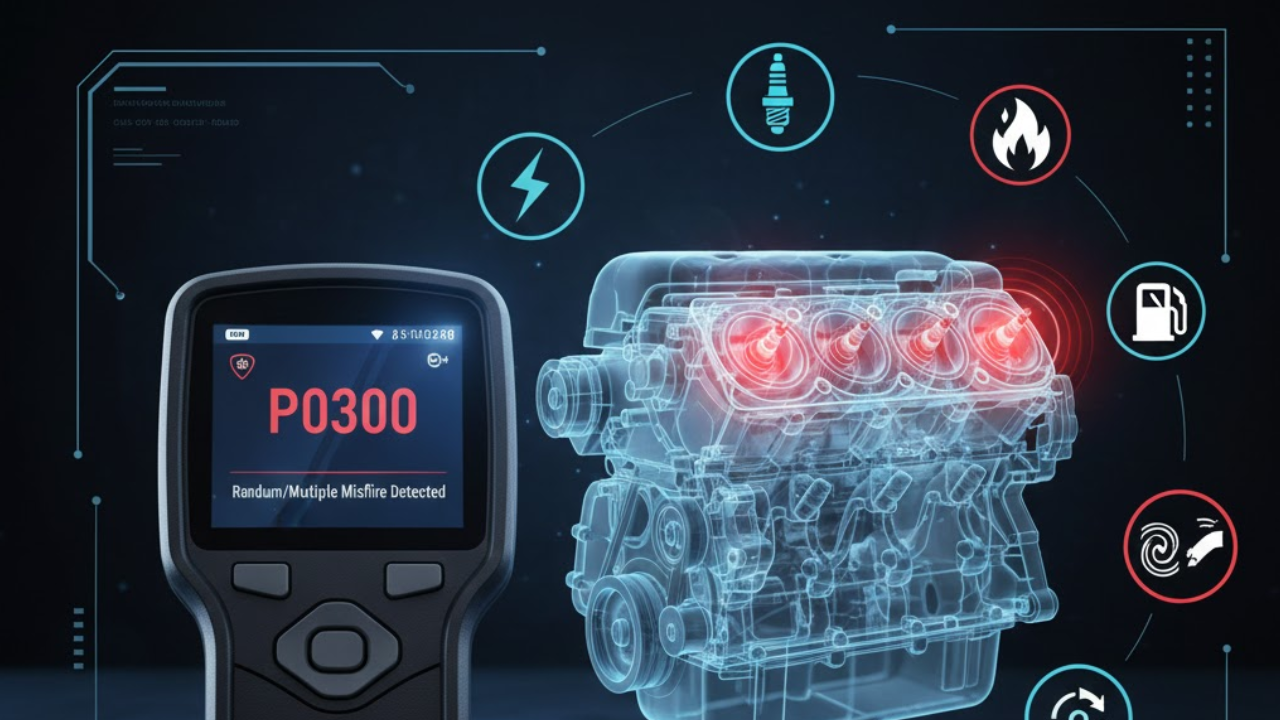
Figure 1: TOPDON Diagnostic Scanner — Professional OBD2 tool displaying P0300 Random/Multiple Cylinder Misfire Detected with engine diagnostics.
🔴 P0300 Code: Random/Multiple Cylinder Misfire Detected | Complete Guide
P0300 stands for "Random/Multiple Cylinder Misfire Detected." This generic OBD-II code means the Engine Control Module (ECM) has detected that one or more cylinders are not firing properly — but the misfires are not concentrated in any single cylinder. They are "random," hopping from cylinder to cylinder. This pattern points to a shared system failure that affects all cylinders: fuel pressure, vacuum leaks, MAF sensor, contaminated fuel, or timing issues. P0300 is often accompanied by cylinder-specific codes (P0301-P0312) that identify which cylinders are actually misfiring. A flashing Check Engine Light with P0300 is a critical emergency — raw fuel is entering the catalytic converter, risking fire and converter destruction.
📑 Table of Contents
🔍 What Does P0300 Mean?
The P0300 diagnostic trouble code (DTC) is a generic OBD-II code indicating that the vehicle's engine control unit (ECU) has detected random or multiple cylinder misfires. Unlike cylinder-specific codes (P0301-P0312), P0300 does not pinpoint which cylinder is misfiring — it indicates that misfires are occurring across multiple cylinders in an unpredictable pattern.
A misfire occurs when the air-fuel mixture in a cylinder fails to ignite properly or at all. This can happen due to problems with the ignition system, fuel system, air intake system, or internal engine mechanical issues.
The ECM monitors misfires by tracking the crankshaft position sensor. When a cylinder fires, it produces a specific acceleration in crankshaft rotation. If the expected acceleration does not occur, the ECM counts a misfire. If misfires exceed a calibrated threshold across multiple cylinders, P0300 is set.
Because P0300 is "random," the underlying cause typically affects all cylinders equally:
- Fuel delivery issues — low fuel pressure, clogged filter, weak pump
- Air intake problems — vacuum leaks, dirty MAF sensor, clogged air filter
- Contaminated fuel — water, dirt, or wrong octane rating
- Timing issues — jumped timing belt/chain, faulty camshaft sensor
- Shared ignition components — distributor cap, coil pack, or wiring harness
P0300 is almost always accompanied by cylinder-specific codes (P0301, P0302, etc.). The specific codes tell you WHICH cylinders are misfiring, while P0300 tells you the problem is systemic (affecting multiple cylinders). Always read ALL codes before diagnosing — the specific codes are your roadmap to the root cause.
⚡ Diagram 1: Ignition System — Battery, Coil, Distributor, Spark Plugs
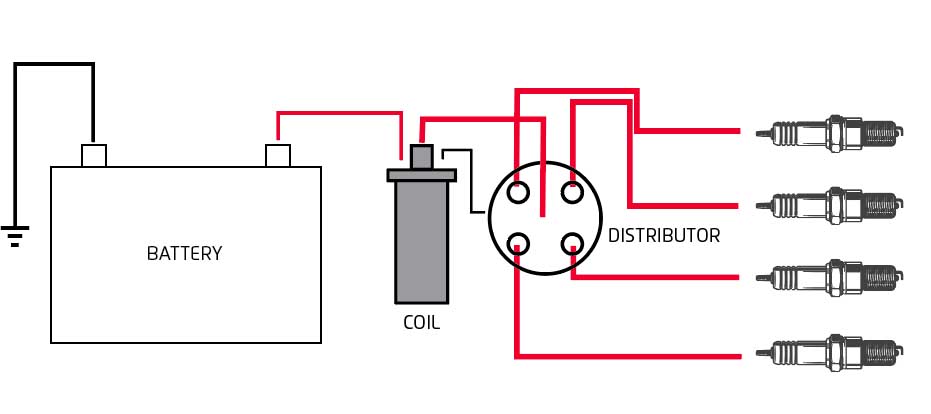
Figure 2: Complete ignition system diagram — how voltage flows from the battery through the coil and distributor to the spark plugs, igniting the air-fuel mixture in each cylinder.
⚡ Diagram 2: Waste Spark Ignition System (V-Engine)
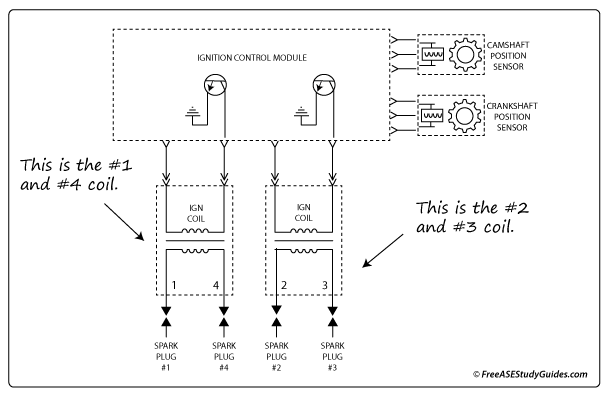
Figure 3: Waste spark ignition system used in many V6/V8 engines — paired cylinders share a single ignition coil. A fault in one coil affects two cylinders simultaneously.
⚠️ Symptoms of P0300 Code
P0300 produces noticeable drivability issues that worsen under load:
| Symptom | Severity | Description |
|---|---|---|
| 🔴 Check Engine Light ON | High | Steady or flashing CEL. P0300 stored, often with P0301-P0312. |
| 🔴 Flashing CEL | Critical | Severe misfire dumping raw fuel into catalytic converter. Stop immediately! |
| 🚗 Rough Idle | High | Engine shakes at idle, steering wheel vibrates, cabin feels shuddering. |
| 🐌 Poor Acceleration / Power Loss | High | Sluggish response, hesitation under throttle, reduced power by 10-30%. |
| 🔊 Engine Stumbling / Jerking | High | Engine cuts out momentarily during acceleration, feels like "hiccups." |
| ⛽ Increased Fuel Consumption | Medium | Unburned fuel exits through exhaust. MPG drops 10-25%. |
| 💨 Dark / Smelly Exhaust | Medium | Black smoke (rich) or raw fuel smell from unburned fuel in exhaust. |
| ❌ Failed Emissions Test | High | High hydrocarbon (HC) and carbon monoxide (CO) emissions. |
| 🌡️ Catalytic Converter Overheating | Critical | Raw fuel burns in converter, causing glowing red converter and fire risk. |
| 🚗 Hard Starting / Long Crank | Medium | Misfires make cold starts difficult, extended cranking time. |
A flashing Check Engine Light with P0300 means the misfire is severe enough to damage the catalytic converter. The ECM has detected that unburned fuel is entering the exhaust system. STOP DRIVING IMMEDIATELY — continuing to drive can cause the catalytic converter to overheat, melt internally, and potentially catch fire. This is a $1,000-$2,500 repair if ignored.
🔧 Common Causes of P0300 Code
Because P0300 is a random/multiple misfire code, the cause typically affects the entire engine, not just one cylinder. Here are the causes ranked by likelihood:
1. Worn or Faulty Spark Plugs — ~35% of Cases
The single most common cause of P0300. Spark plugs have a finite lifespan:
- Copper plugs: 20,000-30,000 miles
- Platinum plugs: 60,000-80,000 miles
- Iridium plugs: 80,000-120,000 miles
As electrodes wear, the gap widens, the spark weakens, and eventually the plug cannot reliably ignite the mixture. Worn plugs cause misfires across ALL cylinders, triggering P0300.
2. Failed Ignition Coils — ~25% of Cases
On modern coil-on-plug (COP) systems, each cylinder has its own ignition coil. On older distributor or waste-spark systems, a single coil or coil pack serves multiple cylinders. Coil failure causes:
- Coil-on-plug: One bad coil = one cylinder misfire (P030x specific code)
- Waste-spark or coil pack: One bad coil = TWO cylinders misfire (triggers P0300)
Coils fail from heat cycling and age, typically after 80,000-150,000 miles.
3. Clogged or Faulty Fuel Injectors — ~15% of Cases
Fuel injectors spray atomized fuel into the intake ports. When clogged:
- Under-delivery: Lean mixture that won't ignite (lean misfire)
- Leaking injector: Over-rich mixture that fouls plugs (rich misfire)
- Electrical failure: No fuel delivery at all
Carbon buildup from low-quality fuel is the primary cause of injector clogging.
⛽ Diagram 3: Clogged vs Clean Fuel Injector Spray Pattern
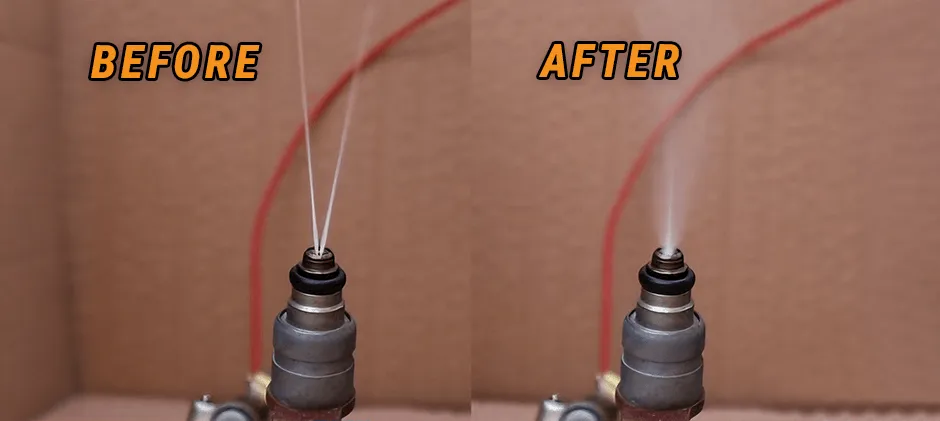
Figure 4: Fuel injector spray pattern comparison — clogged injector (left) produces a weak, uneven stream. Clean injector (right) produces a fine, atomized cone spray for proper combustion.
4. Vacuum Leaks — ~10% of Cases
Unmetered air entering the intake manifold causes a lean condition:
- Cracked vacuum hoses — age and heat degrade rubber hoses
- Torn intake manifold gasket — gasket failure allows air in
- Broken PCV valve — stuck open, creating a massive vacuum leak
- Loose intake hose clamps — after air filter service
Vacuum leaks cause misfires especially at idle, improving at higher RPM.
5. Low Fuel Pressure — ~8% of Cases
Weak fuel delivery starves all cylinders:
- Failing fuel pump — weak output, especially under load
- Clogged fuel filter — restricts flow to injectors
- Faulty fuel pressure regulator — incorrect pressure to rail
- Dirty fuel — water or debris clogs filter and injectors
6. Faulty MAF or Oxygen Sensors — ~5% of Cases
These sensors control fuel mixture. A faulty sensor causes incorrect fuel delivery:
- Dirty MAF sensor — under-reads airflow, causing lean mixture
- Stuck O2 sensor — ECM miscalculates fuel trim, causing rich or lean misfires
Usually accompanied by P0171 (lean) or P0172 (rich) codes.
7. Internal Engine Mechanical Issues — ~2% of Cases
Serious mechanical problems that reduce compression:
- Worn piston rings — low compression, poor combustion
- Burned valves — compression leak, incomplete combustion
- Blown head gasket — coolant in cylinders, compression loss
- Jumped timing chain/belt — valves open/close at wrong time
- Broken valve spring or lifter — valve doesn't seat properly
When you see P0300, always check for accompanying codes first. If P0300 appears ALONE (no P0301-P0312), the cause is almost certainly a shared system: fuel pressure, vacuum leak, MAF sensor, or contaminated fuel. If P0300 appears WITH specific cylinder codes, start with the components on those specific cylinders.
🚗 Vehicles Most Commonly Affected by P0300
P0300 can appear on any vehicle with OBD-II (1996+), but some engines are more prone due to design:
| Brand | Common Models | Known Issues |
|---|---|---|
| Ford | F-150, Explorer, Mustang, Focus, Escape | 3.5L EcoBoost — carbon buildup on intake valves. COP coils fail from heat. TSB for PCM reflash. |
| Chevrolet / GMC | Silverado, Equinox, Cruze, Malibu, Tahoe | 3.6L V6 — AFM lifter failure causes misfires. 1.4L Turbo — PCV valve issues. Direct injection carbon. |
| Toyota | Camry, Corolla, RAV4, Tacoma, Highlander | 2.5L — excessive oil consumption fouls plugs. 3.5L V6 — ignition coil failure common at 80k+ miles. |
| Honda | Civic, Accord, CR-V, Odyssey, Pilot | J35 V6 — VCM (cylinder deactivation) causes plug fouling. 1.5L Turbo — oil dilution from fuel in oil. |
| BMW | 3-Series, 5-Series, X3, X5 | N20/N26 4-cylinder — ignition coil failure. N55/N63 — direct injection carbon buildup. VANOS timing issues. |
| Volkswagen | Jetta, Golf, Passat, Tiguan | 2.0T TSI — intake valve carbon buildup ( walnut blasting needed). Ignition coil packs fail regularly. |
| Nissan | Altima, Maxima, Murano, Rogue | VQ35DE — ignition coil failure. QR25DE — excessive oil consumption fouls plugs. MAF contamination. |
| Hyundai / Kia | Sonata, Elantra, Tucson, Sportage | Theta II 2.0L/2.4L — engine recall for connecting rod bearings. 1.6L Turbo — carbon buildup. |
🛠️ How to Diagnose P0300 Code (Step-by-Step)
Systematic diagnosis is essential because P0300 has many possible causes. Follow this proven approach:
Step 1: Scan for ALL Codes with OBD2 Scanner
Use a quality scanner (like TOPDON Phoenix Nano, Autel MK808, Launch X431, or Thinkcar ThinkOBD) to read all stored and pending codes:
- P0300 alone → Shared system failure (fuel, air, vacuum, timing)
- P0300 + P0301, P0304 → Check what cylinders 1 & 4 share (coil pack, fuel rail, intake runner)
- P0300 + P0171/P0172 → Fuel trim issue causing lean/rich misfires
- P0300 + P0420/P0430 → Misfires have damaged catalytic converter
- P0300 + P0011/P0016 → Timing issue (VVT, chain, belt)
📱 Recommended Scanner: TOPDON Phoenix Nano
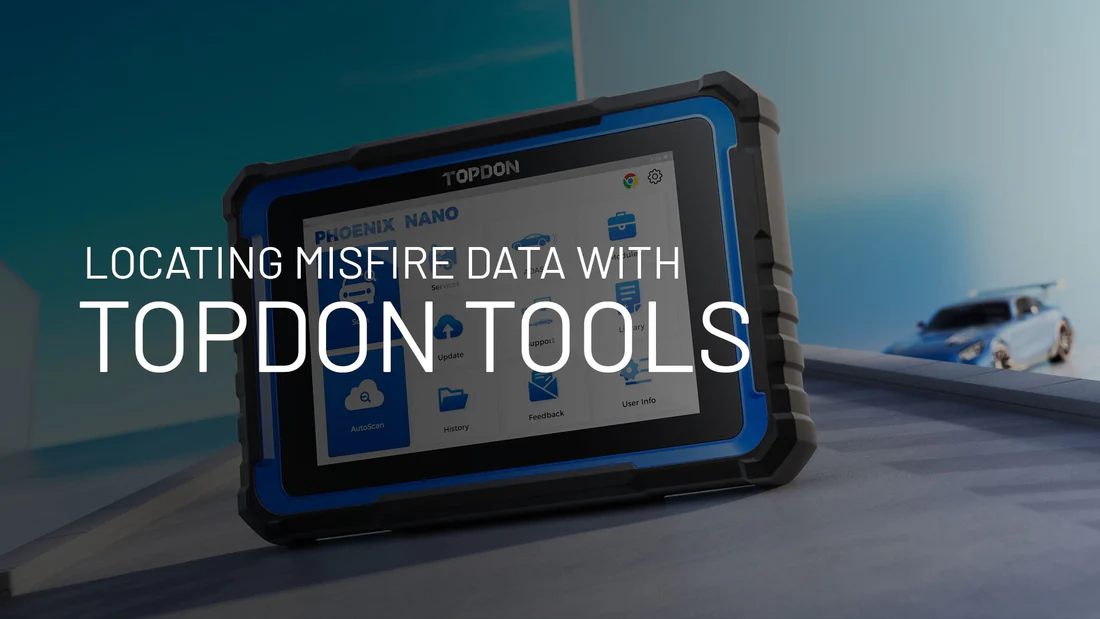
Figure 5: TOPDON Phoenix Nano — Full-system diagnostic tablet with misfire data monitoring, live data graphs, and bi-directional control functions.
Step 2: Identify the Misfire Pattern
Use your scanner's misfire counter (Mode $06 data) to see which cylinders are misfiring and how often:
- All cylinders misfiring equally → Fuel pressure, vacuum leak, MAF, or contaminated fuel
- Two adjacent cylinders misfiring → Head gasket failure between those cylinders
- One cylinder misfiring heavily → Spark plug, coil, or injector on that cylinder
- Misfires only at idle → Vacuum leak or low compression
- Misfires only under load → Fuel delivery or ignition weakness
Step 3: Visual Inspection
- Spark plug wells — oil or coolant in wells causes misfire (indicates valve cover gasket leak)
- Ignition coils — burn marks, cracks, or carbon tracking on coil boots
- Vacuum hoses — cracks, splits, or disconnected hoses
- Intake manifold — signs of gasket leak (sooty deposits at seams)
- Air filter — excessively dirty filter restricts airflow
Step 4: The Swap Test (For Single or Paired Cylinder Misfires)
The most effective DIY diagnostic for cylinder-specific misfires:
- Swap the ignition coil from the misfiring cylinder to a known-good cylinder
- Clear codes and test drive
- If the misfire follows the coil → Bad coil (replace it)
- If the misfire stays in the original cylinder → Coil is fine; problem is plug or injector
- Repeat with spark plugs if coil swap didn't identify the cause
🔧 Diagram 4: Cylinder Compression Test
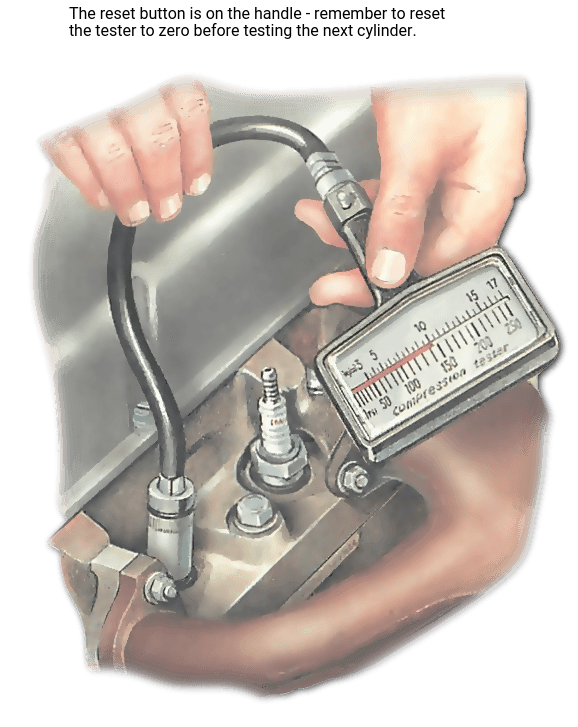
Figure 6: Compression test procedure — remove the spark plug, thread in the compression gauge, and crank the engine to measure cylinder pressure.
Step 5: Check Fuel System
- Fuel pressure test: Connect gauge to fuel rail test port. Compare to spec (typically 40-60 PSI for port injection, 1,500-3,000 PSI for direct injection).
- Listen to injectors: Use mechanic's stethoscope — each injector should produce a sharp "clicking" sound.
- Injector balance test: Compare fuel flow from each injector (professional tool).
Step 6: Check for Vacuum Leaks
- Smoke test: Best method — inject smoke into intake, watch for leaks
- Propane enrichment: Spray propane around intake manifold — if RPM increases, you found a leak
- Soapy water: Spray on vacuum hoses — bubbles indicate leaks
- Listen: Hissing sound from engine bay indicates vacuum leak
Step 7: Compression Test (If Other Tests Pass)
If ignition and fuel systems are good, test mechanical health:
- Remove all spark plugs
- Thread compression gauge into each cylinder
- Crank engine 5-6 revolutions
- Record pressure for each cylinder
- Normal: 150-200 PSI (varies by engine)
- Acceptable variance: Within 15% of highest cylinder
- Low compression: Worn rings, burned valves, or head gasket
🔧 Diagram 5: Compression Test Gauge Kit
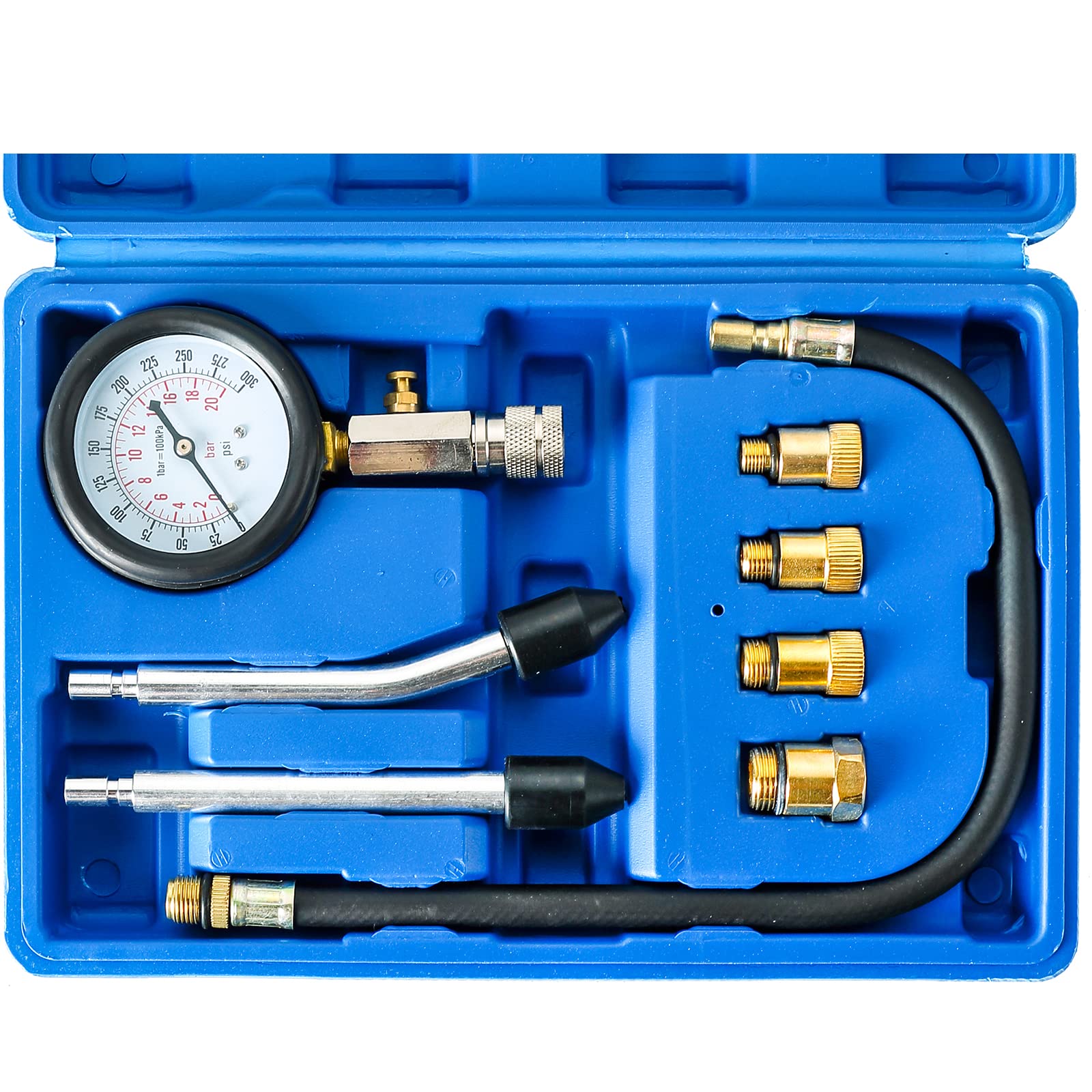
Figure 7: Professional compression test kit — includes pressure gauge, flexible hose, and multiple adapters for different spark plug thread sizes.
Step 8: Check Timing Components
- Timing belt/chain: Inspect for wear, stretching, or jumped teeth
- VVT solenoids: Test with multimeter for proper resistance
- Camshaft position sensors: Check for proper signal output
- Crankshaft position sensor: Verify signal consistency
Before replacing parts, confirm:
- ✅ All codes read and documented (P0300 + any P0301-P0312, P0171, P0420, etc.)
- ✅ Misfire pattern identified (all cylinders vs specific cylinders)
- ✅ Visual inspection complete (plugs, coils, hoses, leaks)
- ✅ Swap test performed (for cylinder-specific misfires)
- ✅ Fuel pressure tested and within spec
- ✅ Vacuum leak test performed (smoke, propane, or soapy water)
- ✅ Compression test done (if mechanical failure suspected)
- ✅ Timing components inspected
🔩 Step-by-Step Repair Guide for P0300
Based on your diagnosis, follow the appropriate repair path:
Option A: Replace Spark Plugs (Most Common Fix)
- Buy correct plugs — match OEM spec (heat range, gap, material)
- Allow engine to cool — hot engine makes plug removal difficult
- Remove coil-on-plug units or plug wires — one at a time to avoid mixing up
- Inspect plug wells — oil or coolant indicates gasket leak (fix first)
- Remove old plugs — use proper socket and extension
- Check gap on new plugs — even "pre-gapped" plugs should be verified
- Install new plugs — hand-tighten, then torque to spec (typically 15-25 Nm)
- Apply dielectric grease — to coil boots to prevent corrosion
- Reinstall coils/wires — ensure full seating and locking clips engaged
- Clear codes and test drive — 20 minutes varied driving
Option B: Replace Ignition Coils
- Identify faulty coil(s) — via swap test or misfire counter data
- Disconnect battery — negative terminal
- Remove coil connector — press locking tab
- Remove mounting bolt — typically 10mm
- Pull coil straight up — do not twist or rock (damages boot)
- Inspect coil boot — burn marks, cracks, or carbon tracking = replace
- Install new coil — push firmly until seated, install bolt
- Reconnect connector — ensure click
- Clear codes and test drive
Option C: Clean or Replace Fuel Injectors
- Try fuel injector cleaner first — add to tank (Sea Foam, Techron, or Lucas)
- Drive 50-100 miles — highway speeds help cleaner work
- If no improvement: Professional ultrasonic cleaning ($30-$60 per injector)
- If electrical failure: Replace injector ($80-$300 each, depending on vehicle)
- Direct injection engines: May require intake valve cleaning (walnut blasting $300-$600)
🧽 Diagram 6: Fuel System Cleaning Effect Comparison
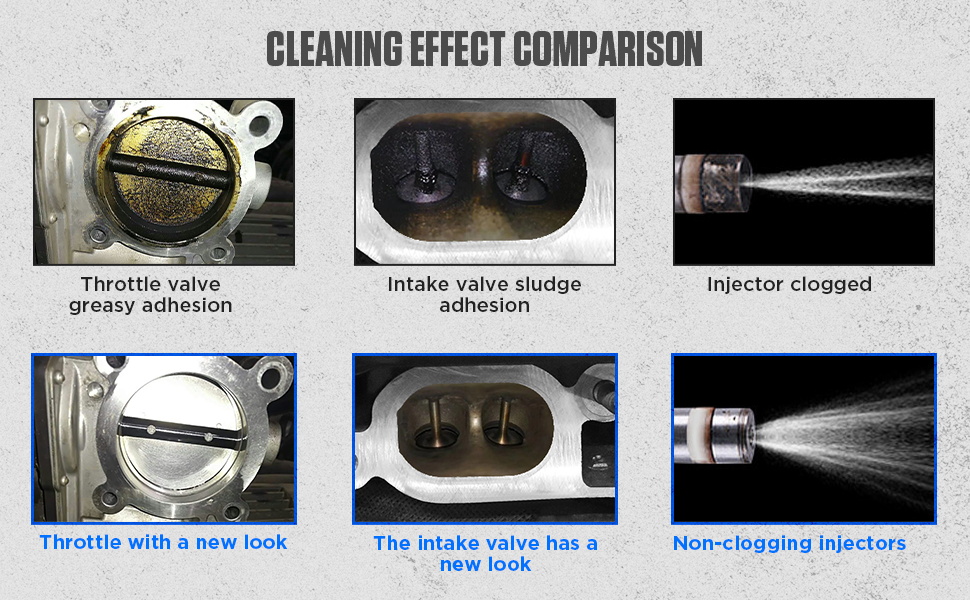
Figure 8: Before/after comparison of throttle valve, intake valve, and fuel injector — showing the dramatic effect of carbon buildup vs clean components.
Option D: Repair Vacuum Leaks
- Identify leak location — smoke test, propane test, or visual inspection
- Replace cracked hoses — use OEM-spec vacuum hose (not generic fuel line)
- Replace intake manifold gasket — if gasket is leaking
- Replace PCV valve — if stuck open or clogged
- Retighten hose clamps — on intake boot and air filter housing
- Clear codes and verify — idle should smooth out immediately
Option E: Replace Fuel Pump or Filter
- Confirm low fuel pressure — with gauge test
- Replace fuel filter first — cheapest fix, often clogged
- If pressure still low: Replace fuel pump ($200-$800 depending on vehicle)
- Some vehicles: Fuel pump is in-tank, requiring tank drop ($500-$1,200 labor)
Option F: Major Engine Repair (Worst Case)
- Head gasket replacement: $1,000-$3,000 (includes machining)
- Valve job: $800-$2,500 (remove head, regrind valves, new seals)
- Engine rebuild: $2,500-$6,000 (rings, bearings, pistons, machining)
- Engine replacement: $3,000-$8,000 (used or remanufactured)
Never ignore P0300 with a flashing CEL. Raw fuel entering the catalytic converter can overheat it to 1,500°F+ within minutes, causing the converter to glow red and potentially catch fire. If you see a flashing CEL, pull over safely, turn off the engine, and call for a tow. The cost of a tow ($75-$150) is nothing compared to a $1,500-$2,500 catalytic converter replacement.
💰 P0300 Repair Cost by Country (2026 Updated)
Repair costs vary dramatically based on the root cause:
| Repair Type | 🇺🇸 USA | 🇬🇧 UK | 🇦🇪 UAE | 🇮🇳 India |
|---|---|---|---|---|
| Spark Plug Replacement (4-cylinder, parts + labor) | $100 – $300 | £80 – £240 | AED 370 – AED 1,100 | ₹3,000 – ₹12,000 |
| Spark Plug Replacement (V6/V8, parts + labor) | $200 – $500 | £160 – £400 | AED 740 – AED 1,850 | ₹6,000 – ₹20,000 |
| Ignition Coil Replacement (1 coil, parts + labor) | $100 – $300 | £80 – £240 | AED 370 – AED 1,100 | ₹3,000 – ₹12,000 |
| All Coils + Plugs (V6, complete set) | $400 – $900 | £320 – £720 | AED 1,500 – AED 3,300 | ₹12,000 – ₹36,000 |
| Fuel Injector Cleaning (ultrasonic, all 4) | $120 – $250 | £100 – £200 | AED 450 – AED 900 | ₹3,500 – ₹8,000 |
| Fuel Injector Replacement (1 injector, parts + labor) | $150 – $400 | £120 – £320 | AED 550 – AED 1,500 | ₹4,000 – ₹15,000 |
| Vacuum Leak Repair (hose/gasket replacement) | $100 – $400 | £80 – £320 | AED 370 – AED 1,500 | ₹3,000 – ₹12,000 |
| Fuel Pump Replacement (in-tank, parts + labor) | $400 – $1,200 | £320 – £960 | AED 1,500 – AED 4,500 | ₹12,000 – ₹40,000 |
| Head Gasket Replacement (parts + labor + machining) | $1,000 – $3,000 | £800 – £2,400 | AED 3,700 – AED 11,000 | ₹30,000 – ₹90,000 |
| Engine Rebuild (rings, bearings, machining) | $2,500 – $6,000 | £2,000 – £4,800 | AED 9,200 – AED 22,000 | ₹75,000 – ₹1,80,000 |
💡 Most Common Fix Cost:
Spark Plugs: $100 – $300 | Coils: $100 – $400 | Injectors: $150 – $600
80% of P0300 cases are fixed with plugs, coils, or injectors under $500.
🚦 Can I Drive With P0300 Code?
Short answer: Short distances only — avoid heavy load and fix immediately.
| Scenario | Can You Drive? | Risk Level |
|---|---|---|
| Steady CEL, mild rough idle | Yes — to mechanic only | Medium |
| Flashing CEL | NO — Stop immediately | Critical |
| Multiple cylinders misfiring | Limited — avoid highways | High |
| Towing or hauling | NO — Avoid completely | Very High |
| Strong fuel smell from exhaust | NO — Stop immediately | Critical |
| Catalytic converter glowing red | NO — Fire hazard! | Critical |
- Catalytic converter destruction ($1,500-$2,500 replacement)
- Engine damage from unburned fuel washing cylinder walls (oil dilution)
- Piston, ring, and bearing damage from sustained misfires
- Failed emissions test — cannot renew registration
- Fire hazard from glowing catalytic converter
- Complete engine failure in worst cases ($4,000-$10,000+)
🔴 How Serious Is P0300 Code?
P0300 is a high severity code. While a steady CEL with mild misfires is manageable for short trips, a flashing CEL is a critical emergency.
Severity Scale: 8/10
- Immediate danger: Medium (steady CEL) to Critical (flashing CEL)
- Long-term engine risk: Very High (catalytic converter damage, piston scoring)
- Financial risk: High (simple fix $100, ignored damage $4,000+)
- Fire risk: Critical (flashing CEL = converter can catch fire)
Recommended Action: Diagnose and repair within 1-3 days for steady CEL. Immediately for flashing CEL.
❌ Common Mistakes Mechanics Make With P0300
| Mistake | Why It's Wrong | Cost of Error |
|---|---|---|
| Replacing all coils without testing | One bad coil doesn't mean all are bad. Wastes $300-$800 on unnecessary parts. | $300 – $800 |
| Not checking for cylinder-specific codes | P0300 + P0302 means cylinder 2 is the main culprit. Fix cylinder 2 first, not random parts. | $100 – $500 |
| Ignoring vacuum leaks | A $20 vacuum hose causes P0300. Replacing $500 in ignition parts won't fix it. | $20 – $500 |
| Not testing fuel pressure | Low fuel pressure mimics ignition misfires. New plugs and coils won't help. | $100 – $400 |
| Skipping compression test | Low compression from head gasket or rings won't be fixed by plugs or coils. Wastes time and money. | $500 – $2,000 |
| Reusing old gaskets during plug service | Valve cover or intake gaskets leak oil into plug wells, causing new misfires. Always replace gaskets. | $100 – $400 |
| Not clearing codes after repair | Old codes mask new problems. Always clear and test drive to verify. | Time only |
Before spending a dollar on parts, invest in a $30-$80 OBD2 scanner with live data (like TOPDON ArtiDiag or Thinkcar ThinkOBD). Watching misfire counters in real-time while swapping coils and plugs will identify the faulty cylinder in under 15 minutes — saving you from guessing and buying unnecessary parts.
🛡️ Prevention Tips: How to Avoid P0300 in the Future
- Replace spark plugs on schedule — don't wait until they fail. Follow manufacturer interval.
- Use quality fuel — Top Tier gasoline from reputable stations. Avoid cheap fuel with high contaminants.
- Change fuel filter regularly — every 30,000-50,000 miles to protect injectors.
- Clean MAF sensor annually — use MAF cleaner spray (not brake cleaner) to prevent false readings.
- Inspect vacuum hoses — during every oil change. Replace cracked hoses immediately.
- Use fuel injector cleaner — every 10,000 miles to prevent carbon buildup.
- Fix oil leaks promptly — oil in spark plug wells causes misfires. Replace valve cover gasket.
- Don't ignore CEL — address codes immediately before they cause secondary damage.
- Use correct octane fuel — follow manufacturer recommendation. Wrong octane causes knock and misfire.
- Service PCV system — replace PCV valve every 50,000 miles to prevent vacuum leaks and oil contamination.
❓ Frequently Asked Questions (FAQs) About P0300
🔗 Related DTC Articles
📝 Final Thoughts
The P0300 code is one of the most common — and potentially most damaging — OBD-II trouble codes. While it often stems from simple, inexpensive issues like worn spark plugs or a faulty ignition coil, ignoring it can lead to catastrophic catalytic converter damage and engine failure. The key to saving money is systematic diagnosis: read all codes, identify the misfire pattern, perform the swap test, and rule out shared system failures before replacing parts.
Remember: a flashing Check Engine Light is an emergency. It means raw fuel is entering your catalytic converter. Stop driving immediately, call for a tow, and get the issue fixed before you face a $2,000+ converter replacement. A $100 spark plug change is always cheaper than a $2,000 converter replacement.
- Scan for ALL codes — P0300 + any P0301-P0312, P0171, P0420, etc.
- Identify misfire pattern — all cylinders vs specific cylinders
- Visual inspection — plugs, coils, hoses, leaks
- Perform swap test — move coils/plugs to identify faulty component
- Check fuel pressure — low pressure causes random misfires
- Test for vacuum leaks — smoke test or propane test
- Compression test — if mechanical failure suspected
- Replace faulty parts — plugs, coils, injectors, or gaskets
- Clear codes and test drive 20 minutes to verify
- NEVER drive with flashing CEL — stop immediately!
📌 Bookmark this page for future reference!
If you found this guide helpful, share it with fellow car owners and mechanics.
Last Updated: July 15, 2026 | AL Ansari Automobile


.jpg)


.jpg)


0 Comments
please do not enter Any spam words link in the comment box..